
Scoliosis: Expertise and Innovation at Hospital CMQ

¿Qué es la Escoliosis?

Medically reviewed by Óscar Morales, MD. Traumatology and OrthopedicsLast reviewed:

Reading time: 2 minutes

About the author: Dr. Oscar Morales is a renowned spine surgery specialist who works at Hospital CMQ in Puerto Vallarta. He completed his medical training at the University of Guadalajara, one of the most prestigious institutions in the country, obtaining his medical degree at the CUCS medical school. Subsequently, he continued his academic studies with a specialty in Orthopedics and Traumatology at the Universidad Juárez Autonoma de Tabasco. Later on, he continued with his passion for surgery and completed a high specialty in Spine Surgery endorsed by the UNAM. His constant search for knowledge has kept him up-to-date with the latest techniques and progress in the field of spine surgery.

Quick answer

Scoliosis is a sideways curvature of the spine, most often diagnosed during the growth spurt just before puberty. Many cases are mild and simply monitored over time, while more significant curves may need bracing or, less commonly, surgery to prevent the curve from progressing.

What Is Scoliosis?

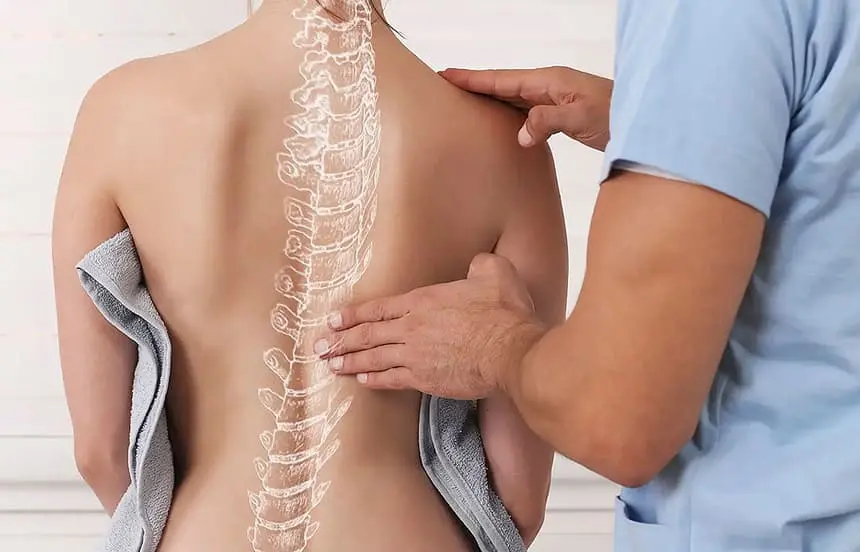
A healthy spine appears straight when viewed from behind. In scoliosis, the spine curves to the side, often in an S or C shape, and may also rotate slightly. Curves are measured in degrees using X-rays, which helps guide how closely the condition needs to be monitored or treated.

What Are the Signs?

  • Uneven shoulders, with one shoulder blade more prominent than the other
  • An uneven waistline
  • One hip higher than the other
  • A visible curve in the back when bending forward
  • In more advanced cases, back pain or, rarely, breathing difficulty

What Causes Scoliosis?

Most cases in adolescents have no identifiable cause and are called idiopathic scoliosis, often first noticed during a growth spurt. Less commonly, scoliosis can be present from birth (congenital), related to a neuromuscular condition, or develop later in life due to age-related degeneration of the spine (degenerative scoliosis).

How Is Scoliosis Diagnosed?

A physical exam, including a forward-bend test, often raises the first suspicion. An X-ray of the spine confirms the diagnosis and measures the curve's angle (the Cobb angle), which is the main factor doctors use to decide on monitoring versus active treatment.

How Is Scoliosis Treated?

  • Observation: mild curves are often simply monitored with periodic X-rays, especially in growing children
  • Bracing: moderate curves in growing children may be managed with a brace to prevent further progression
  • Surgery: significant curves, or those that continue to progress despite bracing, may be treated with spinal fusion to straighten and stabilize the spine

Everything in One Place

From the first X-ray to bracing decisions or surgical planning, Hospital CMQ's spine team follows scoliosis through every stage — pediatric or adult — without needing to refer patients elsewhere for imaging, treatment, or follow-up.

Ask our spine specialists to evaluate a suspected curve at any age.

References

  • American Academy of Orthopaedic Surgeons — Scoliosis
  • Mayo Clinic — Scoliosis overview
  • Scoliosis Research Society — Patient information

Dr Óscar Morales

Óscar Morales

Minimally Invasive Spine Surgery Specialist

Dr. Oscar Morales is a renowned spine surgery specialist who works in our Hospital CMQ in Puerto Vallarta. He completed his medical training at the University of Guadalajara, one of the most prestigious institutions in the country, obtaining his medical degree at the CUCS medical school. Subsequently, he continued his academic studies with a specialty in Orthopedics and Traumatology at the Universidad Juárez Autonoma de Tabasco. Later on, he continued with his passion for surgery and completed a high specialty in Spine Surgery endorsed by the UNAM.

His constant search for knowledge has kept him up-to-date with the latest techniques and progress in the field of spine surgery. Moreover, some of the training courses he has taken in recent years include:

  • Training in minimally invasive spine surgery, University of Nottingham, United Kingdom, 2023.
  • Training at CLEMI, Latin American Center for Minimally Invasive Research and Training, 2023.
  • Refresher training in minimally invasive spine surgery, Prima Vista Center, Germany, 2022.
  • Training in spine surgery, Ulm, Germany, 2022.

Experience of Oscar Morales, MD. Traumatology and Ortopedics

Over several years of experience in surgical practice, Dr. Morales has fine-tuned his minimally invasive surgical skills and multidisciplinary approach to the treatment of spine problems. His experience includes the management of a wide range of conditions, from herniated discs to scoliosis and traumatic spinal injuries. Among his most common surgical procedures are:

  • Traditional spine surgery
  • Minimally invasive spine surgery
  • Endoscopic spine surgery

Make an appointment with our specialist! Dr. Oscar Morales sees patients at Hospital CMQ Premiere on Mondays, Tuesdays, and Thursdays from 4:00 pm to 8:00 pm. Call 322 226 6500 ext. 320 to schedule an appointment.

Read more

Meet our Team

Frequently asked questions

Does scoliosis get worse with age?

It can, particularly during growth spurts in children and sometimes later in life due to degenerative changes, which is why regular monitoring matters at both ends of the age spectrum.

Can exercise fix scoliosis?

Exercise supports overall strength and posture and is often recommended alongside treatment, but it doesn't reverse a structural spinal curve on its own.

Is scoliosis surgery always necessary?

No — most cases are mild and never require surgery. It's typically reserved for significant curves or those that progress despite bracing.

Can adults develop scoliosis for the first time?

Yes. Degenerative scoliosis can develop later in life as the spine's discs and joints wear down, separate from the adolescent form most people associate with the condition.
Médico revisor: Dr. Óscar Morales — Traumatología y Cirugía de Columna (mismo revisor que la versión ES 'Escoliosis', ya entregada, para mantener consistencia clínica).

Share this article

Related articles

Type to search the whole site.